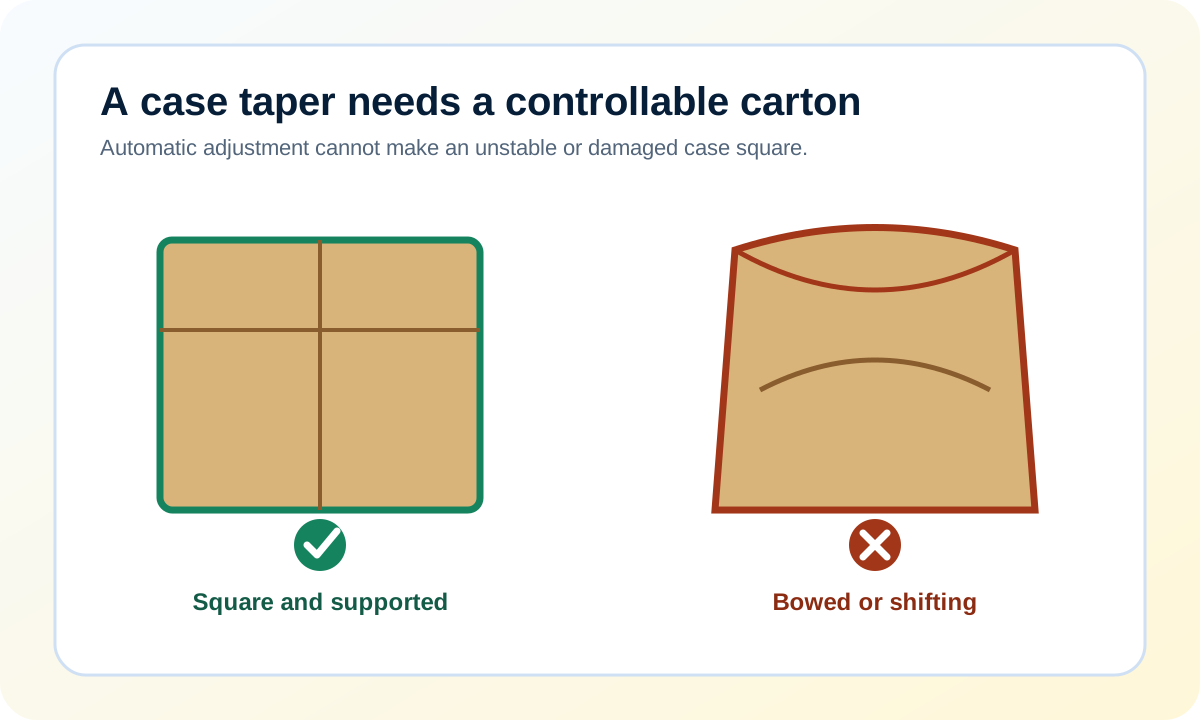
Automatic sealing relies on controlled contact between the carton and the machine. Side belts or guides need stable panels; bottom support needs a predictable base; flap-closing equipment needs flaps that can move into the intended position; and the tape heads need the centre seam to stay within the approved path.
Do not treat instability as a single machine-setting problem. Separate carton construction, product loading, infeed transfer and machine condition. A controlled trial should change one variable at a time and record whether the carton skews, tips, stalls, compresses, opens or produces a poor seal.
| Instability source | Typical observation | What to review |
|---|---|---|
| High or moving contents | Carton leans, rocks or changes behaviour during acceleration. | Dunnage, product restraint, base area, conveyor transitions and speed changes. |
| Weak or distorted board | Side panels bow under belt pressure or seam wanders. | Board condition, storage, compression, overfill and guide pressure. |
| Uneven or damaged base | Carton catches, rotates or loses contact on transfer. | Bottom flaps, protrusions, debris, roller gaps and support surface. |
| Poor flap preparation | Top flaps spring open, overlap incorrectly or resist closing. | Score lines, fill height, flap damage and required closing sequence. |
| Uncontrolled infeed | Carton enters off centre or at an angle. | Guide alignment, merge impact, pitch and upstream release. |
Why can an empty carton give a misleading trial result?
An empty carton has different mass, panel support, centre of gravity and flap behaviour from the filled production case. It may be easier to guide because it is light, or harder because the panels lack internal support. It also cannot show bulging, product movement, overfill or base distortion caused by the real contents.
Use filled samples that represent normal production and credible variation. Where the product cannot be supplied, agree a substitute load that reproduces mass distribution and support, and state the limitation in the test record.
Can tighter guides fix an unstable carton?
Tighter guides may improve centring in some applications, but excessive constraint can compress weak board, mark print, increase friction or create a new jam. Guides cannot correct moving contents, a damaged base, badly folded flaps or a carton whose proportions make it prone to tipping.
Adjustments should follow the machine instructions and be evaluated with seal quality and carton condition. If more pressure is continually needed to keep the carton upright, review the carton and transfer method rather than treating guide force as the only remedy.
Which carton samples should be tested for stability?
Test the smallest, largest and most common filled cartons, plus formats with the highest centre of gravity, weakest board, greatest bulging, most difficult flaps or unusual contents. Include cases from normal storage conditions and realistic packing variation rather than only newly made ideal samples.
For mixed-size operation, test the transition order as well. A stable carton can still be disturbed by the release or adjustment needed for the carton before it.
When should an unstable carton use a different sealing route?
A different route should be considered when the carton cannot be made consistently square and supported, the product movement cannot be controlled, flap preparation is incompatible with the proposed machine, or automatic guidance would risk damage or repeated intervention.
Options may include improving the pack, changing the infeed, using an operator-controlled presentation method or selecting another closure process. The decision should be supported by samples and a site-specific risk assessment, not by forcing an unsuitable carton through the line.