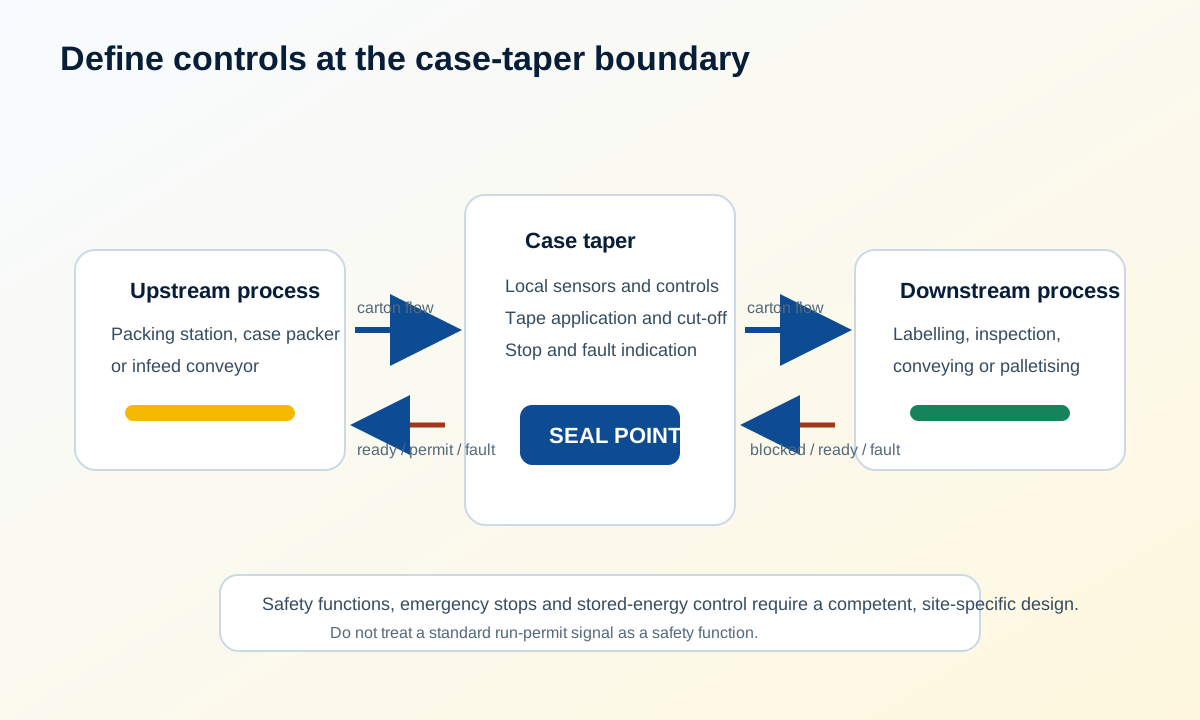
Integration starts with a clear equipment boundary
A mechanically connected conveyor is not automatically a controlled line. Before installation, define which equipment owns carton release, spacing, accumulation, stopping and restart. The case taper may run independently, exchange simple status contacts or participate in a wider PLC-controlled sequence. The correct arrangement depends on the selected machine and the site control philosophy; it should not be assumed from a generic drawing.
Draw the process from the last upstream decision point to the first downstream constraint. Identify sensors, motor zones, operator stations, emergency-stop boundaries and the location where a carton can be safely held. A carton should not be released into the sealer if the sealing zone or outfeed cannot accept it.
Signals to define in the functional description
| Information | Question to answer | Why it matters |
|---|---|---|
| Ready or available | What conditions must be true before the case taper can accept a carton? | Prevents upstream equipment feeding into a stopped or unavailable seal point. |
| Run permit | Who gives permission to run, and what removes it? | Clarifies normal control without treating a standard signal as a safety function. |
| Carton present or released | Where is the carton detected and which device controls spacing? | Reduces tailgating, double feeding and uncertain transitions. |
| Downstream blocked | How much accumulation is available and where should cartons stop? | Avoids a sealed carton stopping inside the machine or colliding at the outfeed. |
| Fault and reset | Which faults are reported, where are they reset and what is the restart sequence? | Prevents unexplained automatic restart or repeated manual intervention. |
| Mode and changeover | How are manual, automatic, maintenance and format conditions controlled? | Keeps local adjustments and line commands consistent. |
Write the stop and restart scenarios
Describe at least the normal start, planned stop, upstream interruption, downstream blockage, case taper fault, emergency stop and power recovery. For each scenario, state what happens to a carton before, inside and after the sealing point. Decide whether the operator must remove a partially processed carton and how the line confirms a clear condition before restart.
For mixed sizes, include the transition sequence. If settings or sensed carton dimensions are used, identify where the format becomes known and what happens when the information is missing or inconsistent. The changeover control guide covers the operational record that should sit alongside the controls description.
Separate production control from safety functions
Ready, blocked and run-permit signals are normally production information. Emergency stopping, guarding, interlocking, safe isolation and prevention of unexpected movement require a competent, site-specific safety design. The final arrangement should reflect the machine instructions, the overall line risk assessment and the responsibilities of the organisations integrating the equipment.
Include the controls evidence in FAT and commissioning
Test each agreed state with representative cartons. Confirm that the upstream process stops before the sealing zone is overfilled, that downstream release is controlled, that faults are visible to the correct operator and that restart does not create an uncontrolled carton movement. Record the expected signal, actual response and any action. The case taper FAT guide provides a structure for those tests.