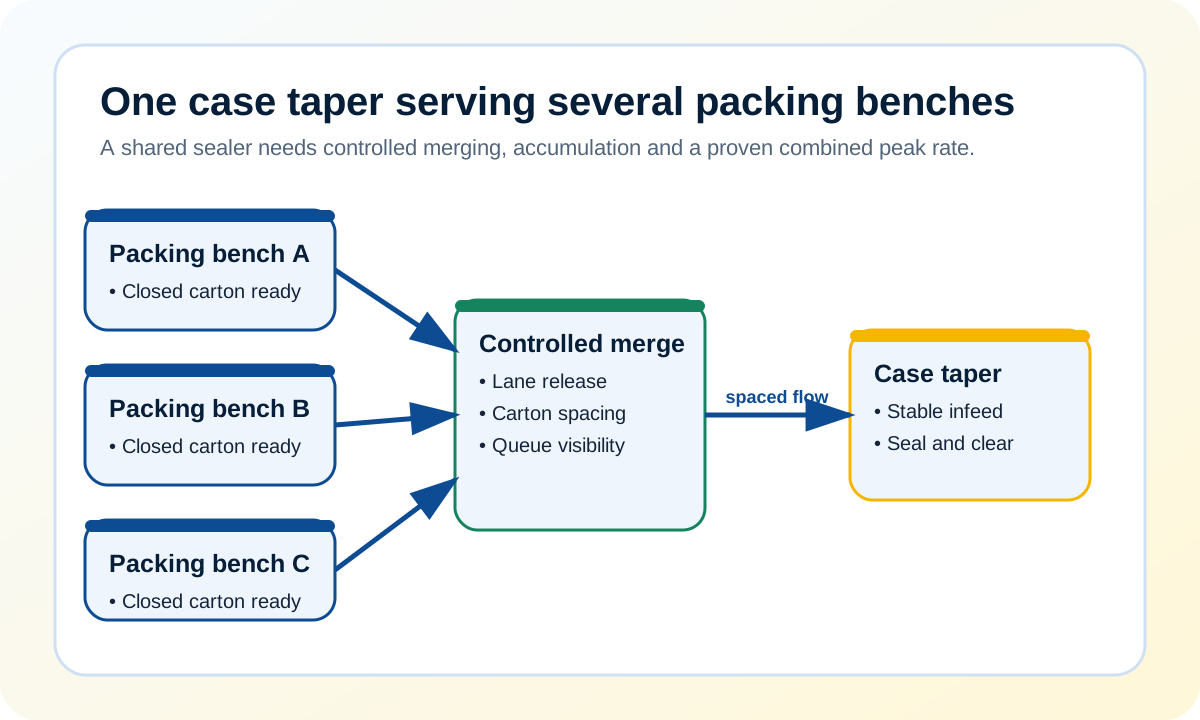
A shared sealing point can reduce duplicated equipment, but the decision should be based on flow rather than the number of benches. Two steady benches may be easier to combine than one highly variable bench with long bursts. The design must account for how finished cartons leave each operator, where they accumulate and whether the case taper receives one format at a time or mixed sizes.
Observe the actual packing pattern over a representative period. Record cartons completed by each bench, simultaneous peaks, carton dimensions, how often operators leave the bench, and the consequences of a stopped sealer. This evidence is more useful than dividing an hourly target by the number of workstations.
| Planning point | Shared case taper can work when | Warning sign |
|---|---|---|
| Merge method | Cartons enter a controlled merge or are manually presented in a defined sequence. | Cartons collide, rotate or block one another at an uncontrolled junction. |
| Accumulation | There is enough controlled queue space for normal short interruptions. | A brief stop immediately blocks each operator’s working area. |
| Carton range | The machine and transfer can handle the combined approved carton matrix. | One bench regularly produces cartons outside the shared machine’s practical range. |
| Operator movement | The sealing route reduces handling or keeps it within an agreed ergonomic method. | Operators carry filled cartons long distances or cross vehicle routes. |
| Fault impact | There is a defined response or temporary alternative for a common-point stop. | One minor fault stops every bench with no managed buffer or recovery plan. |
How should cartons from several packing benches be merged?
Cartons should enter the shared sealer through a controlled merge that maintains orientation, prevents side impacts and provides the gap required by the downstream process. The merge may use conveyors and sensors, a controlled release from each lane or a defined manual presentation method, depending on the site and output.
The merge owner must be explicit. If each bench releases independently, two cartons can reach the junction together. A practical sequence gives one lane permission to release while the other waits, then confirms that the transfer zone is clear before the next carton enters.
How much accumulation is needed before a shared case taper?
Accumulation should absorb normal short differences between bench completion and sealer availability without allowing cartons to press, overlap or lose orientation. The required amount depends on arrival variability, the longest routine interruption, carton length, conveyor control and whether operators can pause safely.
Use observed bursts and stop durations to size the queue. A buffer should not be treated as a substitute for resolving an undersized sealer or frequent faults; it should manage expected variation while preserving safe access and product condition.
What happens when the benches produce different carton sizes?
Different carton sizes can share one sealing point only if the selected machine, guides, belts and transfers can handle the approved range in the order cartons arrive. A uniform machine may require batches and a controlled format change, while a random-size machine may adjust between suitable mixed cartons.
Build a transition matrix rather than testing only the smallest and largest cartons separately. Small-to-large, large-to-small and common-to-common transitions can reveal spacing, centring or adjustment issues that a single-format test will not show.
When are separate case tapers better than one shared machine?
Separate case tapers may be more practical when benches are far apart, carton families are materially different, peak demand is simultaneous, one area needs a distinct hygiene or operating regime, or the cost of stopping every bench at one common point is unacceptable.
Compare the complete operating method: equipment, conveyors, floor space, operator travel, queues, changeovers, fault impact and maintenance access. A lower machine count is not automatically the lowest-cost or most resilient arrangement.