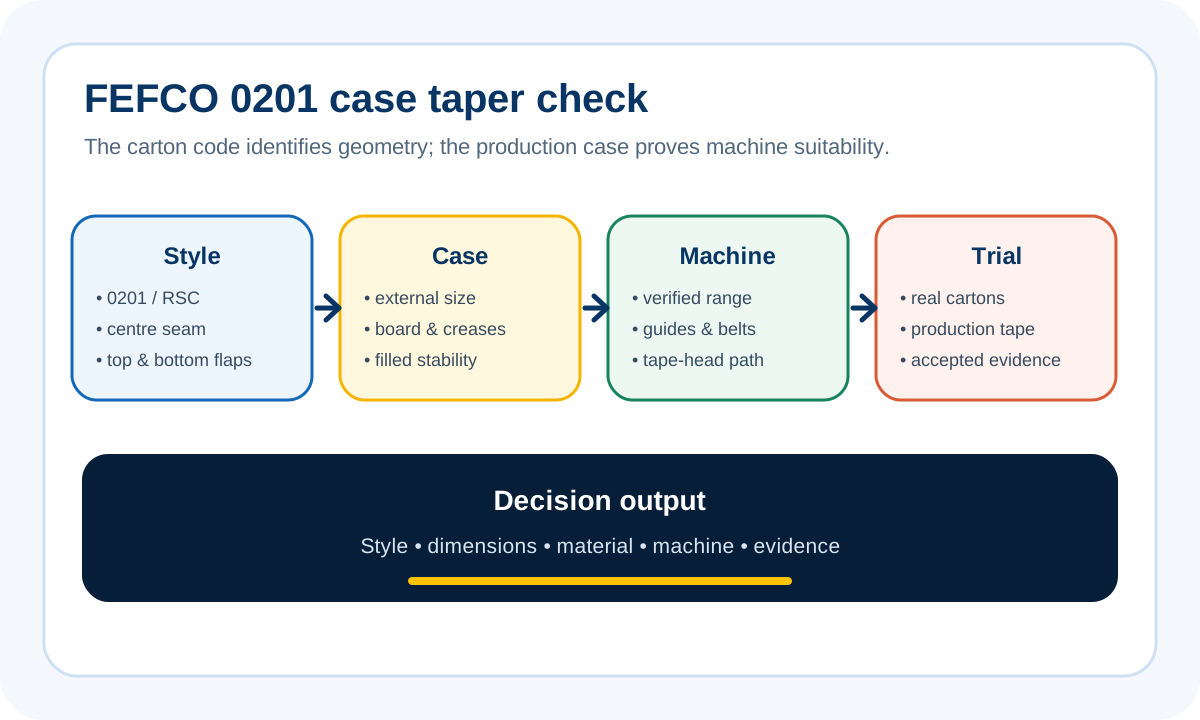
A case taper can usually seal a FEFCO 0201 regular slotted carton when the filled case is square, the outer flaps meet predictably at the centre seam and the external dimensions fall within the selected machine’s verified range. The FEFCO code identifies the carton design, but it does not prove board strength, dimensional consistency, flap condition, filled-case stability or tape compatibility. Those factors still need to be checked with representative production cartons.
What do FEFCO 0201 and RSC mean?
FEFCO is the internationally used coding system for corrugated packaging designs. Code 0201 describes the regular slotted case, commonly shortened to RSC. It is normally made from one corrugated blank with a manufacturer’s joint and top and bottom flaps. When a 0201 carton is closed correctly, the outer flaps meet at the centre line, creating the seam over which a tape head can apply a straight strip of pressure-sensitive tape.
The code is useful because it describes geometry consistently, but it does not specify the carton’s length, width, height, flute, wall construction, board grade, print, coating or allowable load. A machine quotation therefore needs the code and the real production data.
Which FEFCO 0201 details affect case taper selection?
| Carton detail | Why it matters at the case taper | Evidence to provide |
|---|---|---|
| External size | The machine guides, belts, tape-head actuation and available opening are selected around external dimensions rather than the product’s nominal internal size. | Smallest, largest and common external L × W × H values. |
| Flap meeting line | Outer flaps that overlap, leave a gap or spring apart can move the seam away from the expected tape path. | Photographs of the filled carton before and after manual flap closure. |
| Board and crease condition | Weak panels, damaged scores, high flap memory or inconsistent manufacture can produce skew, crushing or lifted tape. | Representative cartons from normal supply batches. |
| Filled-case stability | Loose, high or uneven contents may allow the carton to rack or rotate while belts and guides are trying to control it. | Normal filled samples, weights and orientation. |
| Sealing zone | Print, labels, barcodes, staples, straps or coatings close to the centre seam may conflict with tape position or inspection. | Artwork, label positions and approved tape landing area. |
Are all slotted cartons equally suitable for a case taper?
No. A regular slotted carton is a common case-taper application, but other slotted designs may have partial-overlap or full-overlap flaps, unequal panels or a seam that does not behave like a standard 0201 case. Half-slotted cases, telescopic boxes, die-cut mailers, crash-lock cartons and tuck closures also need a separate review. The machine must be matched to the actual closure geometry rather than the word “carton”.
Where the pack is not a regular centre-seam case, send a closed sample and an open blank. This allows Lancing to identify whether a conventional top-and-bottom tape head is appropriate, whether a different carton orientation is possible or whether another closing process should be considered.
Should case-taper dimensions use internal or external carton size?
Use external dimensions for machine fit and conveyor handling. Internal dimensions describe the available product space; external dimensions describe what the guides, belts, flap controls and tape heads must physically handle. State the measurement convention clearly and include tolerances or batch variation where known. Do not convert from internal to external dimensions by guesswork because board thickness and construction vary.
How should a FEFCO 0201 carton be trialled?
- Identify the carton style and record external dimensions in the normal filled condition.
- Include the smallest, largest, most common and known difficult formats.
- Use the intended production tape and normal carton storage conditions.
- Present cartons using the real operator or upstream process, including flap folding.
- Check top and bottom seam position, tape centring, cut-off, wipe-down and end-tab landing.
- Run stop/restart and, where sizes vary, representative transitions.
- Retain accepted and failed samples with photographs and traceable identifiers.
Technical references for FEFCO carton styles
The FEFCO Code explains the internationally applied coding system for corrugated packaging designs, while FEFCO’s regular slotted case overview describes the RSC manufacturing route. These sources define the carton family; the case-taper decision still requires first-party production samples.